7.5 Real-World Assets
Why DeFi invented the RWA framing rather than TradFi, how $24 billion currently on-chain compares to the $330 trillion global real estate market, and why that gap rather than the technology itself is the actual investment case for tokenized assets.
This entire chapter has covered security tokens and asset-backed tokens without using the term that now dominates institutional conversations, regulatory hearings, and asset manager press releases: Real-World Assets.
That's intentional. "RWA" wasn't the dominant framing when the security token market was forming in 2018. The term came later, and from an unexpected place: not from traditional finance, not from securities lawyers, but from DeFi protocols that needed stable yield after the 2022 crypto crash.
Understanding where the term came from matters. It tells you who is driving this market, what they actually need, and why BlackRock describes its BUIDL fund the way it does. It also opens up a model that Section 7.2 Asset-Backed Tokens didn't cover: RWAs functioning as yield infrastructure inside DeFi protocols, not just as investment products for end investors.
And then there's the scale question. Every category in this taxonomy has growth projections. RWA has something different: a gap between what's currently on-chain and the size of the underlying global asset base that puts every other comparison in perspective.
How "RWA" Became the Dominant Term
"Security token" arrived with a definition: a token that meets the criteria of a security under securities law. That's a regulatory label, not a market category. It tells you how regulators classify the instrument. It says nothing about what the token does, what assets it holds, or why any investor should want it.
This framing created a persistent problem for the STO wave. Between 2018 and 2022, hundreds of projects promised to democratize access to financial assets: fractional real estate, global participation in private funds, 24/7 liquidity for illiquid markets. The pitch had genuine merit. The execution struggled.
Secondary markets stayed thin. Compliance costs were high. Most STOs restricted participation to accredited investors, which undermined the democratization story. The few regulated exchanges that supported security token trading could be counted on one hand. Average daily volume for tZERO's own security token ran at roughly 1,500 shares by 2023. A term that led every conversation with "this is regulated, here's what that means for you" made regulatory overhead the first thing investors heard, before they learned what the asset actually was.
"Real-World Assets" emerged from a different direction entirely. By 2022, DeFi protocols were facing their own problem: native yields had collapsed. Lending protocols that had been offering 15 to 20% APY on stablecoins dropped to near zero. Governance token rewards had inflated away. The search for sustainable, non-speculative returns pointed DeFi developers toward the same answer traditional finance has used for centuries: assets that generate yield in the real world.
MakerDAO was among the first to act at scale. The protocol began allocating USDC from its reserves into US Treasury bonds through off-chain legal structures, earning real-world yield to support DAI's stability. Aave and Compound explored similar integrations. DeFi developers needed a term for this practice: bringing off-chain, real-world collateral onto blockchain rails. They landed on "real-world assets." The term came from DeFi's vocabulary for off-chain collateral, not from the TradFi security token community.
TradFi adopted the framing when institutional players entered in 2023 and 2024. BlackRock doesn't describe its BUIDL fund as a "security token fund." It describes it as a "tokenized fund" investing in "real-world assets." Franklin Templeton calls its BENJI tokens a money market fund investing in real-world government securities. The language signals who the audience is: investors and institutions who care about what the asset represents economically, not its regulatory classification.
The useful distinction: "security token" answers the regulatory question. "RWA" answers the economic one. A BUIDL token is both. One description is regulatory, the other describes what the token actually holds. Neither is wrong. They answer different questions.
| Security Token | Real-World Asset (RWA) | |
|---|---|---|
| Origin | Regulatory community, securities lawyers, 2018 STO wave | DeFi protocols, 2022 — coined as shorthand for off-chain collateral |
| What the label answers | How regulators classify the instrument | What the token actually holds and does economically |
| First thing the audience hears | "This is regulated — here's what that means for you" | "Here's what asset this represents and why it generates yield" |
| Primary audience | Securities lawyers, compliance teams, accredited investors | Portfolio managers, DeFi developers, institutional asset managers |
| Who uses it today | Regulators, compliance teams, legal filings | BlackRock, Franklin Templeton, Ondo Finance, DeFi protocol developers |
| Example products | tZERO security token, Polymath, STO offerings | BlackRock BUIDL, Franklin Templeton BENJI, Ondo OUSG |
| Market result | Thin secondary markets, high compliance overhead, restricted participation | Broader participation, institutional adoption, DeFi composability |
The practical consequence: "RWA" broadens who can discuss and build the market. A portfolio manager who would never attend a "security token conference" will read research on RWA tokenization. A DeFi developer building yield infrastructure doesn't think of their work as operating in the security token space. The terminology shift opened the category to participants who are now its most active builders.
RWA as DeFi Infrastructure
Section 7.2 covered asset-backed tokens as investment products. You buy a token. You own a fraction of a building, a bond, or a fund. The token represents a legal claim on a real-world asset, and you are the end investor.
There's a second model that Section 7.2 doesn't cover: RWAs functioning as yield infrastructure inside DeFi protocols. In this model, you don't buy a token to own a fraction of an asset. You supply liquidity to a protocol that lends against real-world collateral. You hold a credit position against real-world borrowers. The risk profile, legal treatment, and user experience are structurally different.
Understanding how DeFi arrived here requires a brief return to the 2022 bear market. After the Terra/LUNA collapse in May 2022 (which Section 8.4 examines in detail), crypto prices fell roughly 70%. Protocols that had been paying 15% APY on stablecoins dropped to near zero. Token incentives that generated those yields had paid out in governance tokens worth a fraction of their peak value. Sustainable yield, returns that don't depend on token emissions or crypto price appreciation, became the central design challenge for every serious DeFi protocol.
Real-world assets offered an answer. Loans, invoices, trade receivables, and government bonds generate returns regardless of crypto prices. Three protocols built the infrastructure that made this integration work at scale.
Centrifuge brings private credit on-chain. Real-world borrowers, including real estate lenders, invoice financers, and trade receivable originators, pool their assets into on-chain lending pools. DeFi liquidity providers supply capital to those pools and earn yield against real-world collateral. Borrowers access DeFi capital without needing traditional bank relationships. Liquidity providers earn non-speculative yield backed by real-world cash flows. By early 2026, Centrifuge had facilitated over $700 million in total financing and was the first protocol to connect real-world borrowers to DeFi at meaningful scale 1.
Maple Finance operates as an institutional credit marketplace. Borrowers are crypto-native institutions and, increasingly, traditional finance companies. DeFi users act as liquidity providers. Maple's Cash Management product lets DAOs and protocols earn real-world Treasury yield on idle stablecoins. A protocol sitting on $50 million in idle USDC can deploy that capital through Maple to earn 4 to 5% annualized returns, with the yield coming from real-world government securities rather than token incentives 2.
Ondo Finance appears in Section 7.2 as a tokenized fund providing access to US Treasuries. What that section doesn't cover is how OUSG functions inside DeFi. The token is composable: it can serve as collateral in lending protocols, including Ondo's own Flux Finance. A DeFi protocol can hold OUSG as part of its treasury, earn Treasury yield, and still deploy the token as on-chain collateral for other operations. The asset generates yield and remains usable within DeFi simultaneously. BlackRock's BUIDL took its first step into this territory in February 2026 when it listed on UniswapX, marking the beginning of institutional tokenized assets moving into composable DeFi infrastructure 3.
| Protocol | Model | What’s brought on-chain | Who the borrower is | Who supplies capital | Yield source | Total volume / AUM (early 2026, approx.) |
|---|---|---|---|---|---|---|
| Centrifuge | RWA credit marketplace and infrastructure for pools | Asset-backed securities, credit pools, fund shares | Real-world borrowers: SMEs, fintech lenders, asset managers via SPVs | DeFi users, DAOs, and institutions | Interest on real-world credit and structured products | Low-to-mid hundreds of millions to ~1B+ |
| Maple | Institutional on-chain credit platform | Loan pools, permissioned lending markets | Market makers, trading firms, fintech and corporate borrowers | Professional lenders, funds, DAOs, treasuries | Interest from undercollateralized and structured loans | Billions-scale AUM (roughly ~4B) |
| Ondo | Tokenized funds and DeFi wrappers for RWAs | Tokenized Treasuries, bond funds, tokenized ETFs and cash | Underlying is sovereign/ETF issuers; no direct borrower in many products | Retail and institutional via DeFi and partners | Treasury yield, bond coupons, money-market returns | Billions-scale tokenized assets (around ~2–3B) |
This arrangement works in both directions. DeFi protocols get stable, real-world yield that survives bear markets. They can offer sustainable returns without depending on token incentives that inflate and crash. Real-world borrowers and asset managers get DeFi's liquidity, global access, and composability without needing traditional brokerage infrastructure.
The risk profile deserves a direct comparison with Section 7.2's model. When you buy a tokenized real estate token, you own a fraction of an SPV that holds a property. Your risk is tied to that specific asset: property value, vacancy rates, local market conditions, management quality. When you supply liquidity to Centrifuge or Maple, you hold a credit position against a pool of real-world loans. Your risk includes borrower default, pool concentration, and the legal structures governing recovery if borrowers fail to repay. Both models are frequently grouped under the same "RWA" label. They are not the same thing, and treating them as interchangeable leads to poor risk assessment.
| Aspect | RWA as Investment Product | RWA as DeFi Yield Infrastructure |
|---|---|---|
| User role | Investor / LP buying a regulated product | DeFi user or protocol integrator sourcing yield from RWAs |
| What you hold | Fund shares, notes, tokens representing legal claims on assets | LP tokens, vault shares, or receipt tokens linked to RWA strategies |
| Risk exposure | Primarily issuer, asset, and legal/regulatory risk | Smart contract, oracle, protocol, and underlying asset risk |
| Legal structure | Regulated funds/SPVs under securities or fund law | On-chain wrappers around off-chain vehicles, often indirect claims |
| Example protocols | Tokenized Treasuries, real estate funds, private credit funds | Ondo, Maple, Centrifuge-style pools, tokenized T‑bill vaults |
| User experience | KYC/AML, sign docs, limited venues but clear disclosures | Web3 wallet, composability in DeFi, but more opaque legal exposure |
The Ceiling That Changes the Argument
Every number cited in this chapter describes what currently exists: $2.4 billion in BlackRock's BUIDL, $24 billion in total tokenized RWAs excluding stablecoins, a $16 trillion projection from BCG for 2030. These numbers are real and growing. But they're nearly impossible to evaluate without knowing what they're being compared against.
Here is what the global real asset base actually looks like.
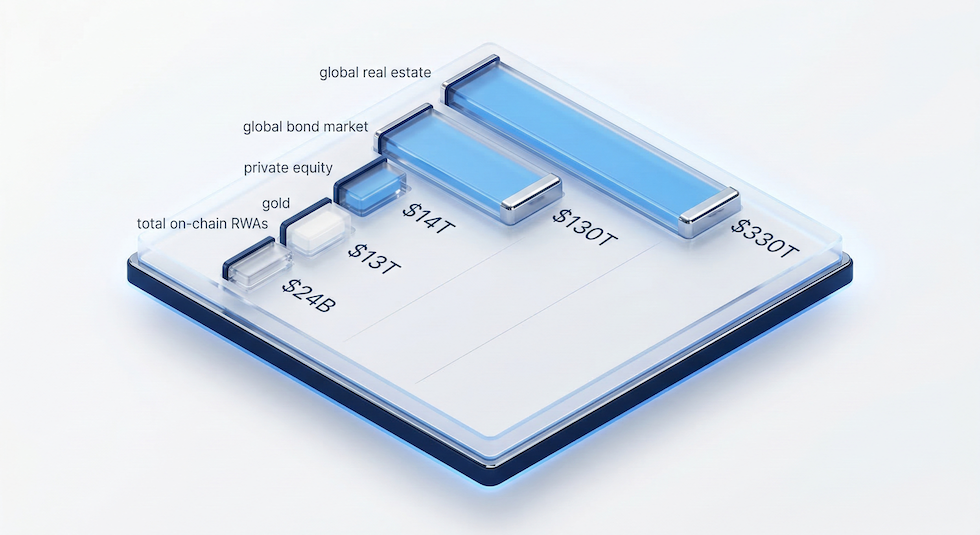
Global real estate: approximately $330 trillion. This single asset class exceeds the combined value of all public stock and bond markets globally. Almost none of it is liquid. Most of it is inaccessible to investors without direct ownership or expensive fund structures with high minimums and long lock-ups.
Global bond market: approximately $130 trillion, covering sovereign debt, corporate bonds, and municipal debt across every major economy. Bonds are accessible to large institutions. For individual investors, the market is largely fragmented and illiquid outside of major index funds.
Private equity: approximately $14 trillion. Private credit: approximately $1.7 trillion and the fastest-growing segment of traditional finance. Apollo, Ares, and Blackstone have been building private credit portfolios aggressively over the past decade. Returns typically run 8 to 12% annually, above public bond yields. The access barrier is severe: minimum check sizes of $1 million or more are common, lock-up periods run 3 to 7 years, and participation is restricted to pension funds, sovereign wealth funds, and ultra-high-net-worth individuals.
Gold: approximately $13 trillion.
Total tokenized RWAs currently on-chain: approximately $24 billion, excluding stablecoins 4.
Even BlackRock's BUIDL at $2.4 billion represents 0.001% of the US bond market. The entire on-chain RWA market is smaller than a rounding error on global real estate.
The investment thesis doesn't require aggressive assumptions. It requires only arithmetic. If 1% of global real estate tokenizes, that's $3.3 trillion in on-chain assets, a market roughly 137 times larger than where things stand today. If 1% of the global bond market tokenizes, that's $1.3 trillion. These aren't speculative targets. They're arithmetic applied to existing asset stocks that already exist, are already generating returns, and are already owned by someone.
Private credit deserves specific attention. It's the fastest-growing asset class in traditional finance precisely because the returns are attractive and institutional demand keeps expanding. But access remains restricted to the largest institutions. Centrifuge and Maple are building on-chain private credit infrastructure, but the gap between what exists on-chain and the total addressable market is enormous. The same lock-up periods and minimum investments that have historically kept private credit exclusive are exactly the friction that tokenization addresses.
The clearest signal comes from the people managing the most capital. In his 2024 annual letter to investors, BlackRock CEO Larry Fink wrote: "We believe the next step will be the tokenization of financial assets — every stock, every bond, every fund — on one ledger" 5. This is not a prediction from a crypto-native founder. It's a product roadmap from the CEO of a firm managing $11.5 trillion in assets. When that firm says tokenization is where the industry goes, the ceiling estimate becomes harder to dismiss as optimism.
Conclusion
The term "RWA" came from DeFi, not from banks or securities lawyers. That origin matters because it shaped who built this market and what they built it for. DeFi protocols needed stable yield after 2022. Traditional finance needed a framing that put economic substance first. Both converged on the same label, and the market they're building together is structurally different from the security token wave that preceded it.
Two models now run in parallel. Asset-backed tokens as investment products, where you buy a fraction of a building or a fund. And RWAs as DeFi yield infrastructure, where real-world collateral backs lending pools that pay sustainable returns without depending on token emissions. They carry different risk profiles, different legal structures, and different user experiences. The "RWA" label covers both. Treating them as the same thing leads to poor decisions.
The ceiling argument is what separates this category from most others in this paper. Governance tokens and utility tokens address markets that are either new or digital-native. Security tokens and RWAs address markets that already exist at a scale measured in hundreds of trillions — real estate, bonds, private credit, gold. Tokenization doesn't create those assets. It changes who can access them, how efficiently ownership transfers, and what can be done with them once they're on-chain. The arithmetic doesn't require optimistic assumptions. It requires only a small percentage of existing assets to move.
The obstacles are real. Liquidity in security token markets remains thin. Compliance costs stay high. Legal structures haven't all been tested under stress. The gap between on-chain records and off-chain reality doesn't disappear because a token exists.
But the direction is clear. Institutional capital is moving toward tokenized infrastructure. DeFi protocols are integrating real-world yield. And the gap between what's currently on-chain and what the global real asset base represents gives this market a runway unlike any other category in this taxonomy.
None of this infrastructure operates without a stable foundation. Every protocol in this chapter settles in the same unit: tokens pegged to the dollar. Centrifuge pools pay out in USDC. Maple's Cash Management runs on idle stablecoins. BlackRock's BUIDL distributes in USDC. Even the Terra/LUNA collapse that redirected DeFi toward real-world yield was, at its core, a stablecoin failure. The asset layer this chapter covers depends on a stability layer it hasn't addressed. That's where Section 8. Stablecoins begins.
- "RWA" came from DeFi, not TradFi: DeFi protocols coined the term in 2022 to describe off-chain collateral that could generate sustainable yield after token incentives collapsed.
- Maple Finance pays DeFi protocols 4-5% annualized Treasury yield on idle stablecoins; real-world assets in DeFi function as yield infrastructure, not just investor products.
- The entire on-chain RWA market totals $24 billion; 1% of global real estate tokenizing alone would produce $3.3 trillion, 137 times the current total.
- Larry Fink's 2024 letter called tokenizing every stock, bond, and fund inevitable; a firm managing $11.5 trillion in assets doesn't make predictions, it announces directions.