4.2 Trading & DeFi Collateral
Why stablecoins dominate cryptocurrency trading and how decentralized lending protocols work.
This section explains how stablecoins serve as the backbone of cryptocurrency trading and lending. You'll learn why exchanges prefer stablecoin pairs, how they function as collateral in DeFi protocols, and practical strategies for getting started safely.
When you buy cryptocurrency, you need a place to trade and something stable to trade against. This is where exchanges and stablecoins work together to create the foundation of crypto markets. Understanding this relationship helps explain why stablecoins processed over $27.6 trillion in annual trading volume in 2024 1.
Understanding cryptocurrency exchanges
A cryptocurrency exchange works like a foreign currency exchange at an airport, but for digital assets. Just as you might exchange euros for dollars, crypto exchanges let you trade Bitcoin for Ethereum, dollars for Bitcoin, or any other supported pair.
There are two main types of exchanges:
Centralized exchanges (CEX) like Coinbase, Binance, and Kraken operate like traditional companies. They hold your assets, match buyers with sellers, and handle the technical complexity. Think of them as banks for cryptocurrency. You trust them with your money, and they provide services like customer support and easy interfaces. The trade-off: they control your funds while they're on the platform.
Decentralized exchanges (DEX) like Uniswap and Curve work differently. Instead of a company holding your assets, smart contracts (automated programs) handle trades directly between users. You keep control of your funds until the moment of trade. While this offers more control, it requires more technical knowledge and personal responsibility for security.
Key Differences: CEX vs DEX
| Feature | Centralized Exchange | Decentralized Exchange |
|---|---|---|
| Asset Custody | Exchange holds funds | You control funds |
| User Experience | Simple, familiar | More complex |
| Trading Speed | Instant | Depends on blockchain |
| Customer Support | Available | Community-based only |
| KYC Required | Usually yes | Usually no |
| Typical Fees | 0.1-0.5% | 0.3% + gas fees |
Why stablecoins dominate trading
On both types of exchanges, stablecoins have become the preferred trading currency. To understand why, consider the alternative: trading between two volatile cryptocurrencies.
Imagine trying to buy Ethereum using Bitcoin. Both prices change constantly. Bitcoin might rise 5% while Ethereum drops 3% in the same hour. When both sides of your trade move, it becomes nearly impossible to track performance or plan strategies. It's like trying to measure distance with a rubber ruler that keeps stretching.
Stablecoins solve this by providing a fixed reference point. When you trade ETH/USDC, only Ethereum's price changes while USDC stays at $1. This makes it simple to calculate profits, set price targets, and understand market movements.
Practical Example: Trading with Stablecoins
Starting position: 1,000 USDC

ETH price when buying: $2,000
You buy: 0.5 ETH for 1,000 USDC

ETH price when selling: $2,400
You sell: 0.5 ETH for 1,200 USDC

Clear profit: 200 USDC (20% gain)
Without stablecoins, tracking this profit would require calculating the relative change between two moving assets, making strategy and tax reporting far more complex.
The numbers tell the story: on Binance, the world's largest exchange, the BTC/USDT pair processes over $2.4 billion daily (as of January 2025) 2. Across all exchanges, stablecoin pairs handle 74% of cryptocurrency trading volume 3. This dominance stems from practical advantages:
- Instant settlement: Move between positions immediately
- Weekend availability: Trade when banks are closed
- Lower fees: Avoid wire transfer costs ($25-45) with transfers under $1
- Tax efficiency: In some jurisdictions, crypto-to-crypto trades have different tax treatment than crypto-to-fiat*
- Mental simplicity: Track profits in familiar dollar terms
*Note: Tax treatment varies significantly by country. Consult local tax professionals for guidance.
Introduction to DeFi and collateral
Decentralized Finance (DeFi) represents a new way of accessing financial services without banks or traditional intermediaries. Instead of a bank approving your loan application, smart contracts automatically manage lending, borrowing, and trading based on predetermined rules.
In traditional finance, collateral is something valuable you pledge to secure a loan, like using your house to get a mortgage. If you can't repay, the lender takes the collateral. DeFi works similarly, but everything happens through code rather than paperwork.
| Feature | Traditional Bank Loan | DeFi Stablecoin Loan |
|---|---|---|
| Approval Time | 3-5 days | Instant |
| Collateral Ratio | Varies (house: 80%) | USDC: 75-85%* |
| Interest Rates | 5-10% fixed | 2-20% variable* |
| Availability | Business hours | 24/7 |
| Paperwork | Extensive | None |
| Minimum Amount | Often $1,000+ | No minimum |
*Rates fluctuate based on supply and demand, checked January 2025
Here's where stablecoins shine. In DeFi lending protocols like Aave or Compound, you can deposit stablecoins as collateral to borrow other cryptocurrencies 4. The process works like this:
- Deposit collateral: You send $10,000 USDC to the protocol
- Borrow against it: You can borrow up to 75-85% of that value in another asset 5
- Pay interest: Variable rates adjust with market demand (typically 5-15% annually)
- Earn simultaneously: Your deposited USDC earns interest (2-8% depending on utilization)
- Maintain safety: Keep your loan below the maximum to avoid liquidation
Why stablecoins make ideal collateral
Lending protocols treat stablecoins preferentially because their value remains predictable. Compare these scenarios:
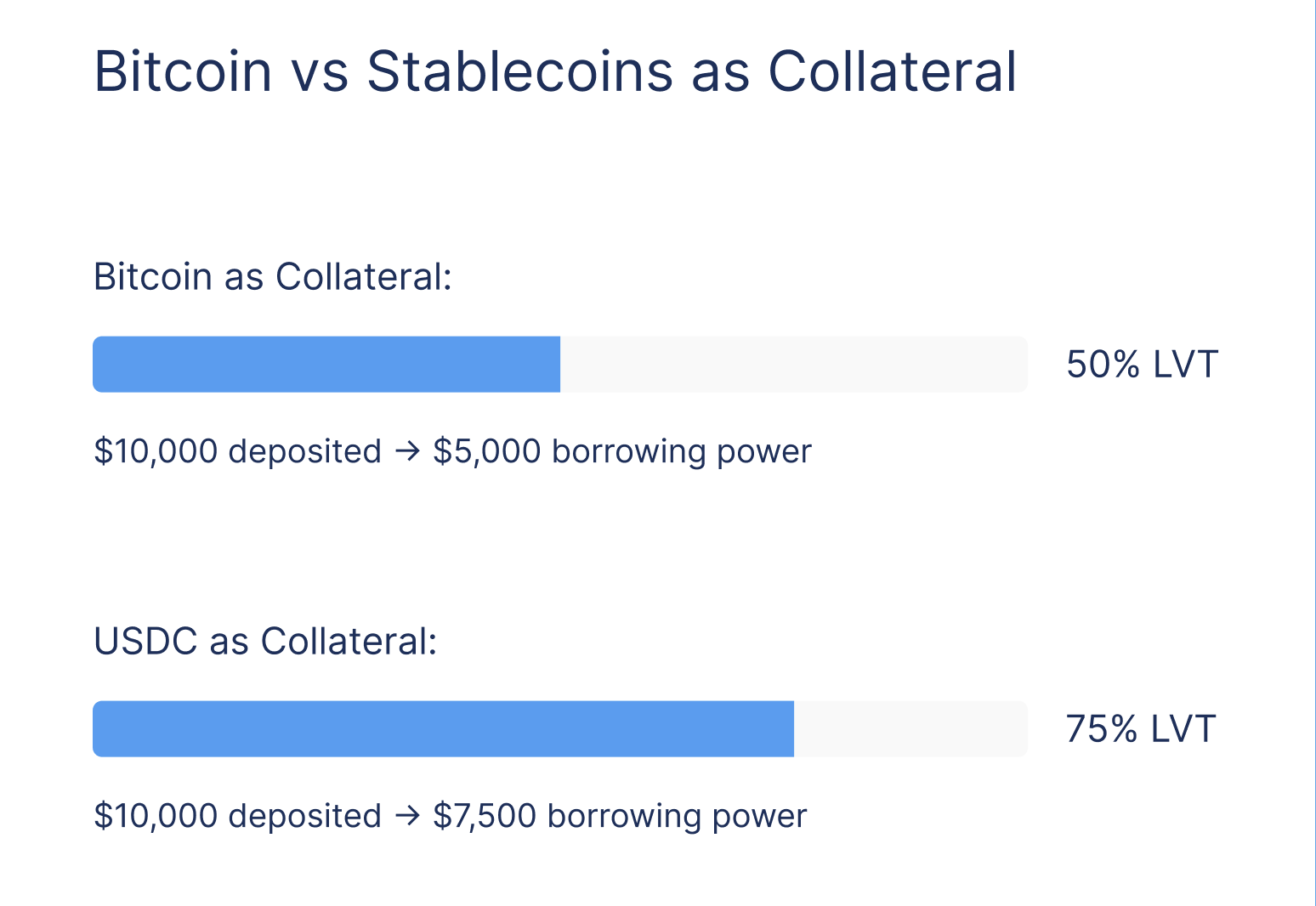
Using Bitcoin as collateral: You deposit $10,000 worth of Bitcoin. Because Bitcoin's price swings wildly, the protocol only lets you borrow $5,000 (50% loan-to-value ratio). If Bitcoin drops 30% overnight, your collateral might not cover your loan, triggering liquidation.
Using stablecoins as collateral: You deposit $10,000 USDC. Since USDC maintains its dollar peg, the protocol lets you borrow $7,500 (75% loan-to-value ratio). The stable value means less risk of sudden liquidation, giving you more borrowing power and peace of mind.
This difference matters for practical strategies. A trader might deposit USDC to borrow Ethereum, betting that ETH will rise. If correct, they profit from Ethereum's growth while keeping their original stablecoins. If wrong, they only lose the interest paid, plus gas fees. Their collateral remains safe as long as they repay the loan.
Recent Market Events
The March 2023 banking crisis briefly caused USDC to trade at $0.87 when Silicon Valley Bank collapsed 6. While the peg recovered within days, this event highlighted that "stable" doesn't mean risk-free. Major protocols adjusted their risk parameters, and traders learned to monitor banking sector health alongside crypto metrics.
Platform preferences and market dynamics
Different platforms favor different stablecoins, creating an interesting ecosystem shaped by regulation, history, and user preferences:
Centralized exchanges heavily favor Tether (USDT), which commands nearly 80% of stablecoin trading volume 7. Binance, OKX, and other major CEXs built their infrastructure around USDT early, creating network effects that persist today. Post-FTX collapse, exchanges have increased transparency around their stablecoin holdings 8.
Decentralized exchanges prefer USD Coin (USDC), which captures 60% of DEX volume 9. This preference reflects USDC's regulatory compliance and transparent backing, important factors when there's no company to provide customer support. The growth has been remarkable: Uniswap's stablecoin-to-stablecoin trading volume reached $23.6 billion in September 2025, representing a 978% increase from $2.19 billion the previous year 10. This explosive growth demonstrates both increasing institutional adoption and the maturation of DEX infrastructure.
Geographic patterns also emerge:
| Region | Most Used Stablecoin(s) | Key Trends & Notes |
|---|---|---|
| Asia | USDT | High liquidity, dominant on exchanges, especially in emerging markets |
| North America | USDC | Preferred for compliance, transparency, institutional integration |
| Europe | USDC, EURS, EURT | MiCA regulation drives diversity, some exchanges delisting USDT |
| Latin America | USDT, USDC | Dollar access needs, growing local stablecoin experiments |
Stablecoin-to-Stablecoin Trading: A Sign of Market Sophistication
The rise in stablecoin-to-stablecoin trading reveals an increasingly sophisticated market. When traders swap USDC for USDT or DAI, they're making nuanced decisions about regulatory risk, yield opportunities, or geographic accessibility rather than simply seeking stability.
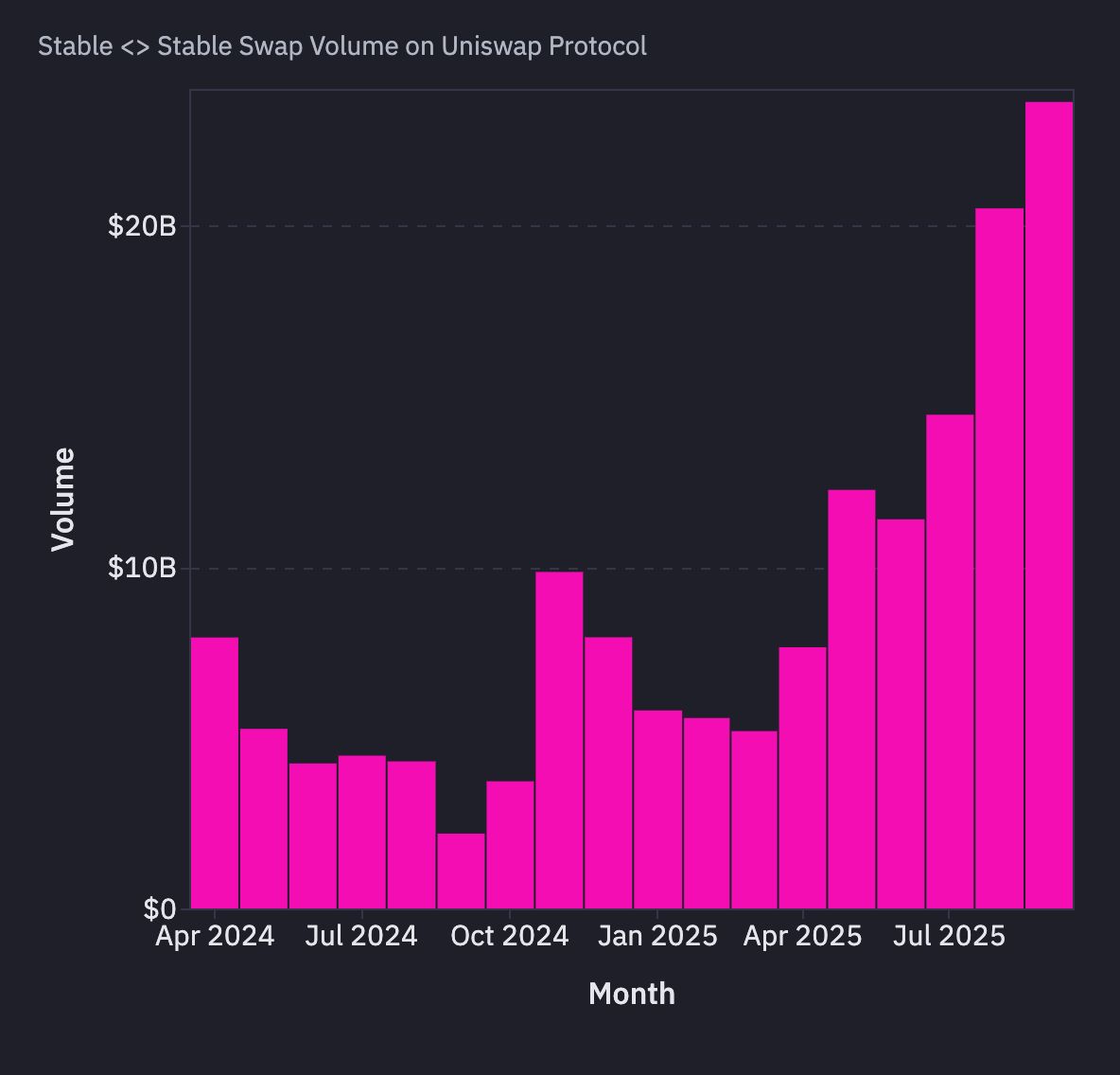
Uniswap data illustrates this evolution clearly. Stable-to-stable swap volume grew from $2.19 billion in September 2024 to $23.6 billion by September 2025, a nearly 11-fold increase 10. This growth suggests several market developments:
- Arbitrage opportunities: Price differences between stablecoins create profitable trading opportunities
- Institutional sophistication: Large traders optimize between different stablecoin properties
- Regulatory positioning: Users switch between stablecoins based on evolving compliance landscapes
- DeFi integration: Protocols increasingly require specific stablecoins, driving conversion demand
Getting started safely
Important disclaimer: This information is for educational purposes only, not financial advice. Cryptocurrency trading and DeFi involve significant risks including total loss of funds. Research thoroughly and never invest more than you can afford to lose.
For newcomers ready to explore stablecoin trading or DeFi collateral, follow these guidelines:
Start with established platforms: Begin on user-friendly centralized exchanges like Coinbase or Kraken. They offer customer support and simpler interfaces while you learn.
Choose mainstream stablecoins: Stick to USDC or USDT initially. Both have proven track records and deep liquidity across platforms. Check current reserve attestations before large transactions.
Practice with small amounts: Your first trades should be learning experiences, not major investments. Trade $100 before risking $10,000. Factor in gas fees, which can be $5-50 per transaction on Ethereum.
Understand the risks:
- Stablecoins can temporarily lose their peg during market stress
- Smart contracts can have bugs leading to loss of funds
- Exchanges can face solvency issues (remember FTX)
- DeFi protocols have been hacked for millions
Graduate gradually: Master simple trading on centralized exchanges before exploring DeFi. When ready for DeFi, start with established protocols like Aave or Compound that have undergone multiple audits.
Risk Ladder: Stablecoin Use Cases
| Use Case | Relative Risk | Key Risks |
|---|---|---|
| Holding on Major CEX | Lowest | Exchange solvency, regulatory changes |
| Simple Trading | Low-Medium | Market volatility, platform issues |
| Providing DEX Liquidity | Medium-High | Impermanent loss, smart contract bugs |
| Leveraged DeFi Positions | Highest | Liquidation cascades, protocol exploits |
The foundation of crypto finance
Stablecoins have become the invisible infrastructure making cryptocurrency markets accessible. By providing stable value for trading and reliable collateral for lending, they bridge the gap between volatile crypto assets and practical usability.
Whether you're making your first trade on Coinbase or exploring DeFi lending on Aave, stablecoins offer the stability needed to participate confidently. As the crypto ecosystem continues evolving, understanding how to use stablecoins for trading and collateral becomes essential knowledge for anyone entering this new financial landscape.
This foundation in trading and collateral naturally leads to our next topic: how businesses leverage stablecoins for treasury management and B2B payments, taking these same principles of stability and efficiency to enterprise scale.
- Stablecoins handle 74% of cryptocurrency trading volume by providing a stable reference point
- DeFi lending allows earning 2-8% on deposits; borrowing up to 85% against stablecoin collateral vs 50% for volatile crypto
- Centralized exchanges favor USDT (80% of volume) while decentralized exchanges prefer USDC (60% of DEX volume)