8.2 Fiat-Collateralized — USDT, USDC
How the two dominant stablecoins maintain their pegs through different approaches to reserves, transparency, and regulation, and why institutions choose one model over the other despite both using the same basic mechanism.
Two companies issue dollar-backed stablecoins. One operates from the British Virgin Islands, declines full audits, and won't publicly disclose which banks hold its $150+ billion in reserves. The other is a licensed US money transmitter with BlackRock managing its reserve fund, publishing monthly attestations from a major accounting firm.
Both maintain a $1 peg using the same basic mechanism. Both have processed trillions in transactions without breaking. Between them, they account for over 90% of the $300 billion stablecoin market 1.
This is the defining paradox of fiat-collateralized stablecoins: the most widely-used instruments in digital finance are built on trust in companies, not code. USDT and USDC don't maintain their pegs through smart contract autonomy or decentralized mechanisms. They work because traders and institutions trust their issuers — for very different reasons, through very different structures. USDT alone processes $187 billion in daily trading volume, frequently exceeding Bitcoin's volume 2. USDC handles settlements for institutional crypto adoption, from Coinbase to Stripe to PayPal 3.
Understanding why requires looking closely at how the mechanism actually works, and what separates two stablecoins that appear identical on the surface. Fiat-backed stablecoins solve the stablecoin trilemma (covered in 8.1 Types of Stability Mechanisms) by optimizing for stability and capital efficiency while accepting centralization. The mechanism is straightforward. The implementation details determine everything.
The Core Mechanism: How Dollar Backing Actually Works
Every USDT and USDC token in circulation theoretically represents one dollar held in reserve. The simplicity makes the model work.
The Basic Cycle:
-
Minting: User deposits $1 million to the issuer's bank account. Issuer mints 1 million new tokens to the user's wallet address. Total supply increases by 1 million.
-
Circulation: User trades, transfers, or holds tokens. The issuer does nothing. Tokens move freely on blockchain networks without the issuer's involvement.
-
Burning: User returns 1 million tokens for redemption. Issuer burns those tokens (destroys them permanently) and wires $1 million back. Total supply decreases by 1 million.
The smart contract mechanics, detailed in 2.2 Smart Contracts and Token Creation, handle the blockchain side. Circle and Tether both use upgradeable proxy contracts that separate token logic from data storage. This architecture allows bug fixes without migrating billions of tokens to new contract addresses.
The contracts include administrative functions that typical ERC-20 tokens lack. Minting functions create new supply when deposits arrive. Burning functions destroy tokens upon redemption. Blacklist functions freeze specific addresses, preventing them from sending or receiving tokens. Pause functions halt all transfers during emergencies. These centralized controls enable the mechanism but contradict cryptocurrency's decentralization ethos.
Arbitrage Maintains the Peg:
Market price occasionally deviates from $1.00. Arbitrage forces convergence:
-
USDC trades at $0.98: Buy USDC on exchanges for $0.98, redeem from Circle for $1.00, pocket $0.02 profit per token. Buying pressure pushes market price back toward $1.00.
-
USDC trades at $1.02: Deposit dollars with Circle, receive USDC at $1.00, sell on exchanges for $1.02, pocket $0.02 profit per token. Selling pressure pushes market price back toward $1.00.
This arbitrage requires direct redemption access. Circle and Tether restrict this privilege to institutional partners: authorized participants who maintain accounts, pass compliance checks, and typically transact in $100,000+ minimums. Retail users trade on secondary markets where arbitrage-driven prices stay near $1.00.
The mechanism fails if reserves disappoint. If an issuer holds only $0.80 for every token, arbitrageurs lose money buying at $0.98 to redeem at $0.80. The peg breaks permanently. This makes reserve quality and transparency the foundation of fiat-backed stablecoins.
USDT (Tether): The Market Leader
Tether launched USDT in 2014, making it the oldest stablecoin still operating at scale 4. Despite years of controversy over transparency and reserve composition, USDT maintains its position as the largest stablecoin by market cap ($150+ billion) and most-used by trading volume 5.
Offshore Structure and Strategic Ambiguity:
Tether Limited operates from the British Virgin Islands, with reserves held at financial institutions worldwide 6. This offshore structure provides regulatory distance from US authorities but creates transparency challenges. Tether doesn't disclose which banks hold reserves or provide real-time verification of backing.
The company's initial claims of "100% backed by USD" proved misleading. In 2021, the CFTC fined Tether $41 million for misrepresenting reserves between 2016 and 2018 7. During much of that period, Tether held only a fraction of the claimed dollar backing, with reserves including loans to affiliated entities and other non-liquid assets.
Post-Crisis Reserve Transformation:
Terra's May 2022 collapse triggered industry-wide scrutiny. Tether responded by completely restructuring reserves. The company eliminated all commercial paper (unsecured short-term corporate debt), the asset category that caused the most concern 8.
Current reserve composition, based on Tether's Q4 2024 attestations 9:
- U.S. Treasury Bills: ~85% (approximately $127 billion)
- Cash and bank deposits: ~10% (approximately $15 billion)
- Other government securities: ~3% (approximately $4.5 billion)
- Precious metals (from profits): ~2% (approximately $3 billion in gold)
- Bitcoin (from profits): <1% (approximately $1 billion)
The gold and Bitcoin holdings come from Tether's operational profits, not the reserves backing tokens. This distinction matters. Tether generates billions annually from reserve yields (5% interest on $150 billion is $7.5 billion per year). The company invests some profits in volatile assets while maintaining dollar reserves for token backing.
Tether publishes quarterly attestations from BDO Italia, an accounting firm that verifies reserve balances at specific moments 10. These attestations don't constitute full audits. As explained in the cross-referenced [[00 Inbox/Stablecoin Paper/2.4 Reserve Management & Reporting|Stablecoin Paper Section 2.4]], attestations photograph reserves at one moment without examining ongoing operations or internal controls. Window dressing remains theoretically possible, though the scale of Tether's operations makes manipulation increasingly difficult.
Demonstrated Resilience Under Stress:
Whatever transparency concerns exist, Tether's operational track record shows resilience under extreme stress. During Terra's May 2022 collapse, panic selling hit all stablecoins. USDT briefly depegged to $0.995 as users rushed for exits 11. During the FTX collapse in November 2022, a second wave of redemption pressure hit the market. Both times, Tether honored redemptions without breaking its peg for more than a few hours 12. Every redemption was paid at full value.
Compare this to traditional finance. When Silicon Valley Bank failed in March 2023, depositors couldn't access funds for days. Money market funds "broke the buck" during the 2008 financial crisis, paying less than $1 per share. Tether's performance during crypto crises arguably exceeds traditional banking's track record during comparable stress.
The Trade-Off: Liquidity Over Transparency:
USDT dominates trading pairs on virtually every crypto exchange globally. Want to trade an obscure altcoin on a Cayman Islands exchange? USDT pairing exists. Need 24/7 liquidity for a position worth $100 million? USDT provides it.
This ubiquity comes from Tether's offshore structure and willingness to integrate with platforms that regulated stablecoins avoid. Binance, the world's largest exchange, primarily uses USDT despite being banned in multiple jurisdictions 13. Smaller exchanges in gray-market jurisdictions adopt USDT because it's available when USDC isn't.
The price is opacity. Users trust Tether's operational history more than its transparency. For traders who need maximum liquidity and don't care about regulatory compliance, USDT remains the standard. For institutions requiring audited reserves and regulatory clarity, USDT's structure creates problems.
USDC (Circle): The Regulated Alternative
Circle launched USDC in 2018 through the Centre Consortium (a partnership with Coinbase) as an explicitly regulated alternative to Tether 14. While USDT optimized for liquidity, USDC optimized for institutional trust through transparency and compliance.
US-Domiciled Structure:
Circle operates as a US-based company registered as a money transmitter in most states 15. This regulatory status requires licenses, compliance infrastructure, and oversight that Tether avoids through its offshore structure. The trade-off is clear: regulatory burden in exchange for institutional legitimacy.
Every USDC holder passes through the same compliance framework that traditional banks use. Creating an account requires identity verification. Large transactions trigger additional scrutiny. Sanctioned addresses get blocked automatically. This matches the infrastructure described in [[7. Security Tokens]], where compliance enables institutional participation despite reducing permissionless access.
Transparent Reserve Management:
Circle publishes monthly attestations from Grant Thornton, a major accounting firm, verifying reserve composition 16. The transparency goes beyond simple balance verification.
Current reserve structure (as of January 2025):
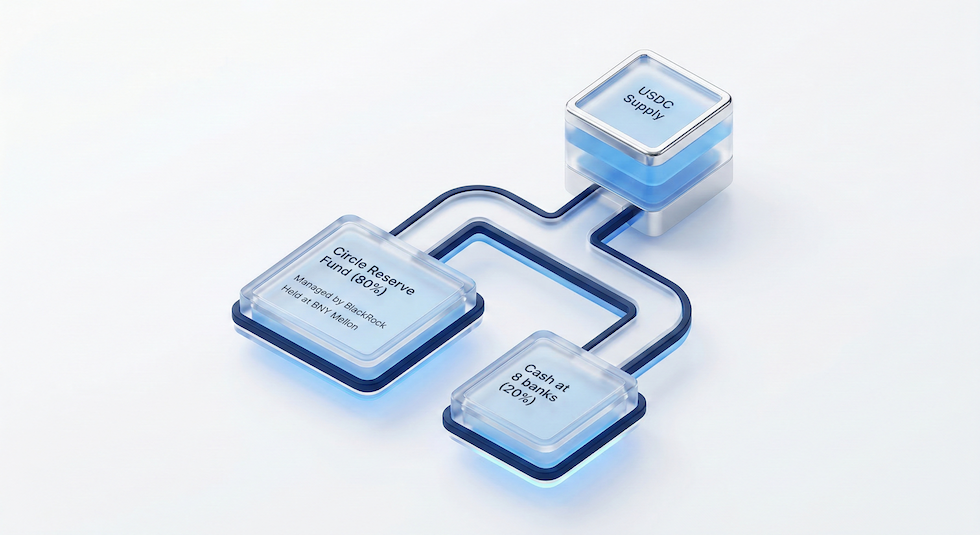
- Circle Reserve Fund: ~80% (managed by BlackRock, held at Bank of New York Mellon)
- Cash at regulated US banks: ~20%
The Circle Reserve Fund invests exclusively in short-term US Treasury bills and overnight repurchase agreements backed by Treasuries 17. This structure mirrors money market funds that institutional investors already trust. BlackRock's involvement signals institutional credibility. BNY Mellon's custody addresses counterparty risk.
Circle diversifies banking relationships across multiple institutions. After Silicon Valley Bank's failure taught painful lessons about concentration risk, Circle expanded to eight different banks 18. No single bank failure can compromise more than 15% of reserves.
The monthly reporting cadence provides regular verification but still represents point-in-time snapshots. Critics note this leaves room for manipulation between reporting periods. Circle counters that the cost and complexity of temporarily arranging $50+ billion in reserves monthly exceeds any benefit from window dressing.
The Silicon Valley Bank Crisis:
March 10, 2023. Silicon Valley Bank fails, the second-largest bank collapse in US history 19. Circle discloses $3.3 billion in reserves trapped at the failed bank 20. USDC immediately depegs, trading as low as $0.87 within hours as panic spreads.
For 72 hours, nobody knew if Circle could honor redemptions. Users holding USDC faced potential 13% losses. Trading volume spiked to record levels as holders rushed to exit. The broader crypto market dropped 10% on concerns about contagion.
March 13, 2023. The Federal Reserve announces emergency measures guaranteeing all SVB deposits 21. Circle confirms full recovery of reserves. USDC returns to $1.00 within hours.
The incident revealed both vulnerability and resilience. Vulnerability because centralized banking dependencies create single points of failure. Even diversified reserves couldn't fully eliminate bank exposure. Resilience because transparent disclosure, regulatory relationships, and government intervention resolved the crisis quickly.
Compare this to Tether's approach. If Tether held $3.3 billion at a failed bank, would users even know? The offshore structure and limited transparency would obscure the problem until redemption failures made it obvious. Circle's transparency created panic but enabled rapid resolution.
Regulatory Positioning for the Future:
Circle positions USDC for the coming regulatory framework. The company actively supports federal stablecoin legislation and complies with Europe's Markets in Crypto-Assets (MiCA) regulation, which took effect in 2024 22.
MiCA requires stablecoin issuers to hold reserves at EU banks, maintain 100% backing with high-quality assets, provide daily reserve reporting, and implement strict governance standards. Circle achieved MiCA compliance for USDC in mid-2024, becoming one of the first stablecoins authorized for European markets under the new rules 23.
The US GENIUS Act, if passed as proposed, would mandate similar requirements: reserves limited to cash and short-term Treasuries, held at regulated custodians, with monthly reporting certified by executives 24. Circle's current structure already meets these standards. Tether's would require substantial changes.
This regulatory readiness creates competitive advantage with institutions but limits operational flexibility. Circle must maintain expensive compliance infrastructure. It cannot integrate with exchanges operating in gray markets. It must block users in sanctioned countries. These restrictions reduce USDC's reach compared to USDT's ubiquity.
Institutional Adoption:
The compliance infrastructure pays off in institutional partnerships. Visa settles payments in USDC 25. Stripe integrated USDC for cross-border transfers 26. PayPal offers USDC trading 27. These companies require regulatory clarity that USDT cannot provide.
BlackRock's tokenized money market fund (BUIDL) uses USDC for subscriptions and redemptions 28. This creates a fascinating cycle: institutions trust USDC because Circle maintains compliant reserves. Circle maintains compliant reserves partially through BlackRock's fund. BlackRock's fund uses USDC for operations. Traditional finance and crypto infrastructure reinforce each other.
The institutional momentum appears durable. The same regulatory requirements that limit USDC's reach to retail traders make it acceptable for corporate treasuries, payment processors, and financial institutions. As discussed in [[00 Inbox/Stablecoin Paper/6. Regulatory Landscape|Stablecoin Paper Section 6]], geographic location and regulatory status determine what options institutions can access. USDC's compliance creates access where USDT's structure creates barriers.
Key Trade-Offs: Why Choose One Over the Other?
Both USDT and USDC use the same stability mechanism. The differences emerge from design choices about transparency, regulation, and target audience.
| USDT | USDC | |
|---|---|---|
| Issuer | Tether (offshore group entities) | Circle Internet Financial |
| Domicile | Offshore (historically BVI/Caribbean) | United States |
| Launched | 2014 | 2018 |
| Market cap (Mar 2026) | ~180B+ | ~80B |
| Daily trading volume | ~100B avg; peaks >200B | Single-digit billions; much lower than USDT |
| Reserve composition | ~80–85% cash + short-term U.S. Treasuries; single-digit % gold; single-digit % BTC/other | ~80% short-dated U.S. Treasuries (Circle Reserve Fund), ~20% cash/overnight repo |
| Reserve manager | Self-managed by Tether (attested by BDO) | BlackRock (Circle Reserve Fund) + bank custodians (e.g., BNY Mellon) |
| Reporting frequency | Quarterly reserve attestation | Monthly reserve attestation |
| Auditor | BDO (BDO Italia reports) | Grant Thornton LLP |
| Regulatory status | Offshore issuer, not licensed under U.S. GENIUS framework | U.S.-regulated issuer; designed for GENIUS + MiCA compliance |
| Address blacklisting | Yes | Yes (hundreds of addresses frozen historically) |
| Primary users | Crypto traders, offshore/derivatives exchanges | Institutions, compliant exchanges, payment processors/fintechs |
| Key stress event | Terra/LUNA collapse – brief wobble but peg held overall | SVB collapse – traded down to ~0.87, re-pegged within days |
| Key partners | Major CEXs (e.g., Binance) and offshore venues | Visa, Stripe, PayPal, BlackRock, major fintechs |
| GENIUS Act readiness | Would require substantial reserve and licensing changes | Already closely aligned with GENIUS requirements |
Custodial Risk:
Both models concentrate risk in centralized entities. If Tether Limited or Circle fails, token holders face potential losses. The Silicon Valley Bank incident demonstrated this vividly: USDC lost 13% of its value for 72 hours because of one bank's failure.
Crypto-collateralized stablecoins like DAI (covered in 8.3 Crypto-Collateralized - DAI) eliminate this specific risk through smart contracts rather than companies. The trade-off is capital efficiency: DAI requires 150-200% collateralization where USDC uses 100%.
Regulatory Risk:
Government authorities can compel Circle or Tether to freeze addresses, seize funds, or halt operations. Both issuers include blacklist functions in their smart contracts that block specific addresses from transacting.
Circle has frozen over 200 addresses at law enforcement request 29. Tether cooperates with authorities despite its offshore structure. This control contradicts cryptocurrency's original promise of permissionless finance.
The counterargument: these same compliance features make stablecoins acceptable to institutions. Banks won't custody assets that enable money laundering. Payment processors won't integrate tokens that violate sanctions. Regulatory cooperation enables mainstream adoption.
Transparency Trade-Offs:
USDC provides superior transparency through monthly attestations, regulated custody, and disclosed banking relationships. This visibility creates confidence but also exposes vulnerabilities. Every user knew Circle had $3.3 billion at Silicon Valley Bank because Circle disclosed it.
Tether's opacity prevents similar panic during problems. Users don't know which banks hold reserves, making targeted concerns difficult. This opacity cuts both ways: it prevents crisis contagion but enables longer-term mismanagement to go undetected.
Liquidity and Access:
USDT's ubiquity across exchanges globally makes it the most liquid stablecoin. Trading pairs exist for thousands of tokens on hundreds of platforms. Offshore exchanges that regulated stablecoins won't touch readily adopt USDT.
USDC's regulatory compliance limits access but attracts institutions. Coinbase, the largest regulated US exchange, primarily uses USDC. PayPal only offers USDC among stablecoins. The division creates two parallel markets: retail crypto traders on USDT, institutions on USDC.
The Convergence: Lessons from Reserve Evolution
Both Tether and Circle dramatically improved reserve quality after Terra's collapse. Tether eliminated commercial paper. Circle partnered with BlackRock for professional asset management. The market demanded higher standards, and issuers responded.
This convergence suggests the market can enforce discipline even without comprehensive regulation. When users question reserves, redemptions spike and pegs break. Issuers face existential pressure to maintain backing. Terra's death served as proof that inadequate reserves destroy stablecoins.
But market discipline has limits. It punishes failure after the fact rather than preventing problems beforehand. Tether's 2016-2018 reserve misrepresentation went undetected until regulatory investigation forced disclosure. Users had no way to verify claims independently.
The emerging solution combines market incentives with regulatory requirements and technological transparency. Regulations mandate reserve quality and reporting. Market competition rewards transparency with institutional adoption. Technology enables real-time verification through on-chain proof of reserves.
This synthesis explains why newer entrants like USDi (Sui's stablecoin backed by BlackRock's BUIDL fund) combine regulated reserves with blockchain-native transparency 30. The token maintains the 1:1 backing that makes fiat stablecoins stable while providing on-chain verification that eliminates trust requirements.
Why These Design Choices Matter
Understanding the differences between USDT and USDC reveals broader lessons about stablecoin design:
No Perfect Solution Exists: USDT optimizes for liquidity and accepts opacity. USDC optimizes for regulatory compliance and accepts limited reach. Both succeed in their target markets. Both face criticism from users who prioritize different trade-offs.
Transparency Costs Money: Circle's compliance infrastructure costs tens of millions annually in licenses, auditors, lawyers, and banking relationships. Tether's offshore structure reduces these costs but creates different risks. Users indirectly pay for either model through opportunity cost of reserve yields.
Regulations Shape Markets: The coming regulatory framework favors USDC's model. Compliance investments made today create competitive advantages tomorrow. But regulations also entrench centralization and limit innovation. The trade-offs remain real.
Trust Matters More Than Code: Both stablecoins depend on trusting companies to maintain reserves and honor redemptions. Smart contracts handle transfers but can't verify bank balances. The transparency mechanisms discussed in [[00 Inbox/Stablecoin Paper/2.4 Reserve Management & Reporting|Stablecoin Paper Section 2.4]] attempt to reduce trust requirements, but fiat-backed models inherently require trusting issuers.
The next section examines how crypto-collateralized stablecoins eliminate issuer trust through smart contracts. DAI's mechanism trades capital efficiency for decentralization, creating different trade-offs than USDT and USDC's fiat-backed approach.
- Tether paid $41 million in CFTC fines for misrepresenting reserves, yet USDT still holds the largest market cap because traders value liquidity over transparency.
- Circle's $3.3 billion SVB exposure crashed USDC to $0.87, but the transparent reporting that caused panic also enabled full recovery in 72 hours.
- USDT processed $7 billion in redemptions during Terra's 48-hour collapse without breaking its peg, despite years of questions about reserve composition.
- Regulatory frameworks like MiCA and the GENIUS Act are being written around Circle's existing compliance model, positioning USDC ahead of Tether as regulation tightens.
- Centralization enables USDC's institutional adoption by Visa, Stripe, and PayPal, but also allows Circle to freeze addresses at law enforcement request, contradicting permissionless finance.