5.2 Voting Mechanisms and DAO Integration
How different voting mechanisms produce radically different governance outcomes, why a system fast enough to fix an $80 million bug in 36 hours is vulnerable to flash attacks, and what the Steemit takeover revealed about whale collusion in practice.
Compound's Proposal 62 had 72 hours to pass. A critical bug let attackers drain $80 million from the protocol. The fix required governance approval, but governance normally took 7 days: 3 days for voting, 2 days for timelock, 2 days buffer. The attack was active. Every hour cost money 1.
The community couldn't bypass governance. The code enforced the delay. But they could coordinate. Major token holders mobilized. Delegates reached out to dormant wallets. Within 36 hours, the proposal hit quorum with 400,000 COMP votes (roughly $100 million in token value). The fix went live just as attackers positioned for a major exploit 2.
This is governance under pressure. The mechanisms that enable decentralized decision-making must work fast enough to matter but slow enough to prevent capture. Every protocol makes different trade-offs. This section examines how the voting infrastructure actually works.
Three major protocols demonstrate different approaches to DAO integration. We'll examine their structural implementations here: the scaffolding of how decisions get made. Section 5.3 then explores how these systems performed when billions of dollars were at stake and governance faced real crises.
The Basic Voting Flow
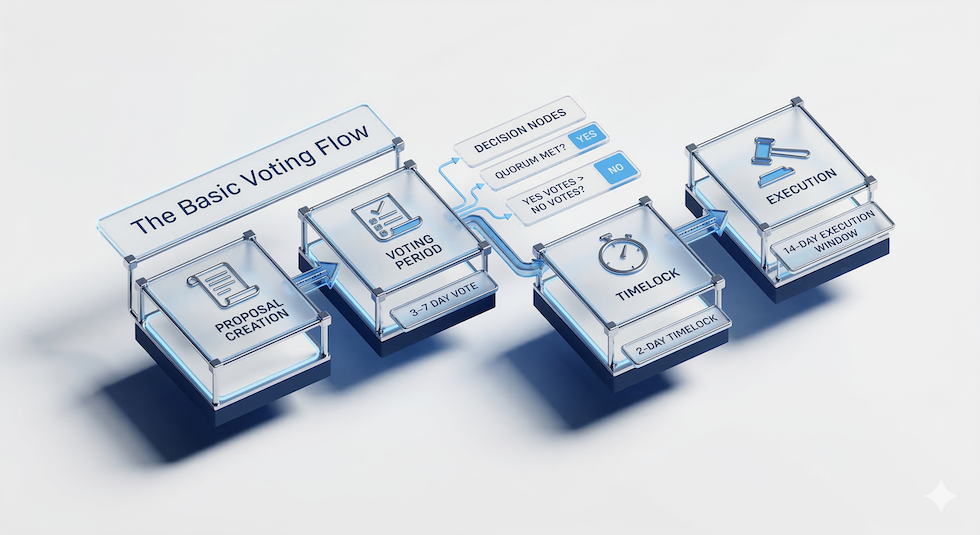
Every governance system follows the same pattern, with variations in timing and thresholds. Most DAOs implement these flows through Governor-style contracts like Governor Bravo or OpenZeppelin's Governor modules.
Step 1: Proposal Creation
Someone with enough tokens submits a formal proposal. Compound requires 25,000 COMP (roughly $1.25 million) to propose 3. Uniswap requires 2.5 million UNI (roughly $15 million) or 2.5 million UNI in delegated votes 4. These thresholds prevent spam while making it expensive to flood governance with bad proposals.
The proposal includes executable code, not just descriptions. For parameter changes, the proposal specifies exactly which smart contract function to call and with what arguments. "Set collateral factor for USDC to 80%" translates to _setCollateralFactor(usdc, 0.8) in the contract 5.
This precision matters. Traditional corporate governance votes on intentions, then management implements however they interpret the vote. Blockchain governance votes on exact code execution. The proposal either passes and executes exactly as written, or it fails and nothing happens. No room for interpretation.
Step 2: Voting Period
Token holders vote during a fixed window, typically 3-7 days. The smart contract records votes on-chain, permanently and publicly. You can verify exactly who voted, how they voted, and how much voting power they wielded.
Vote counting uses token balances at a specific past block (the "snapshot block"), not current balances 6. If you hold 1,000 tokens at block 15,000,000 when the proposal starts, you can vote with 1,000 tokens even if you sell them all before actually casting your vote. This prevents "borrow to vote" attacks where someone borrows millions of tokens from lending protocols, votes, and returns them immediately after.
Most protocols use simple majority rules: yes votes must exceed no votes, with variations like dynamic quorum adjustments or anti-late-quorum extensions that prevent last-minute vote swings. But quorum requirements add complexity.
Compound requires 400,000 COMP minimum participation 3. Uniswap requires 40 million UNI 4. Low participation means even majority support fails. The protocol preserves status quo over hasty changes.
Step 3: Timelock Delay
Passed proposals don't execute immediately. A mandatory delay, typically 2 days, gives the community time to react.
If a malicious proposal passes through vote buying, coordinated attack, or exploit, this 2-day window lets honest users exit before execution. Withdraw funds from Compound. Unstake from Aave. Move assets to safety. The delay acts as a last-resort escape hatch when governance fails.
But the delay also means critical fixes take days to deploy. The Compound bug scenario demonstrates this tension. Every minute counted, but governance still required 72 hours minimum. Fast enough to respond before catastrophic loss, slow enough that attackers had multiple days to prepare countermeasures.
Step 4: Execution
After the timelock expires, anyone can trigger execution by submitting a transaction. The smart contract verifies the proposal passed, the delay elapsed, and the execution window hasn't closed (typically 14 days before proposals expire).
The code runs exactly as specified in the proposal. Change collateral factors. Upgrade contracts. Transfer treasury funds. The blockchain enforces the outcome without intermediaries.
This deterministic execution differentiates blockchain governance from traditional systems. Corporate votes often become suggestions that management weighs against other factors. Protocol votes become irrevocable smart contract state changes. The code doesn't care about second thoughts.
Token-Weighted Voting: The Default Standard
Most governance tokens use simple token-weighted voting: one token equals one vote. Hold 100 tokens, cast 100 votes. Hold 1 million tokens, cast 1 million votes.
The math is straightforward:
Vote Power = Token Balance at Snapshot Block
Proposal Passes = (Yes Votes > No Votes) AND (Total Votes >= Quorum)
This system has one massive advantage: it's simple to understand and implement. Every token holder immediately grasps their voting power. Every developer can build the contracts. Every wallet can integrate voting interfaces.
But token-weighted voting creates plutocracy by design. Whales dominate. Analysis of major protocols shows the concentration:
- Compound: Top 10 addresses control 45% of voting power 7
- Uniswap: Top 20 addresses control 52%
- Aave: Top 10 addresses control 50%+
These whales include venture funds (Andreessen Horowitz, Paradigm), core teams, and early investors who received large allocations. Their interests might align with the protocol's success, but they might also prioritize short-term profits over long-term sustainability.
The concentration gets worse through delegation. Token holders can delegate voting power to other addresses without transferring tokens 8. Professional delegates accumulate millions in voting power by building reputations for good governance decisions. Andreessen Horowitz holds direct token positions plus delegates from smaller holders, giving them even more influence 9.
From an incentive-alignment perspective, this isn't necessarily bad. Large stakeholders have the most to lose from bad decisions. They're incentivized to vote carefully. Small holders often lack the time or expertise to evaluate complex proposals. Delegation to informed voters might often produce better outcomes than forcing everyone to vote on topics they don't understand.
But it does centralize power in ways that conflict with decentralization rhetoric.
Alternative Voting Mechanisms
Several protocols experimented with alternatives to pure token-weighted voting. Each solves some problems while creating others.
Quadratic Voting
Vote cost scales quadratically. Casting 1 vote costs 1 token. Casting 2 votes costs 4 tokens. Casting 10 votes costs 100 tokens. The formula: Vote Cost = Votes² 10.
This reduces whale dominance. Someone with 1 million tokens can't simply cast 1 million votes. They'd need to spend their entire balance to cast 1,000 votes (since 1,000² = 1,000,000). Meanwhile, someone with 100 tokens can cast 10 votes, giving small holders proportionally more influence.
Gitcoin uses quadratic funding for grants (a related but distinct mechanism from quadratic voting), distributing millions to open source projects 11. In practice, most quadratic voting systems use voting credits or points rather than raw tokens, making the Vote Cost = Votes² formula conceptual rather than literal on-chain implementation.
The mechanism successfully prevented whales from capturing the entire grant pool. Projects with broad community support received more funding than projects with single large backers.
But quadratic voting has a fatal flaw for pseudonymous systems: Sybil attacks. Split your 1 million tokens across 100 addresses. Each address holds 10,000 tokens and can cast 100 votes for 10,000 token cost. Total: 10,000 votes for 1 million tokens, versus 1,000 votes if kept in one address.
Defending against this requires identity verification, which conflicts with crypto's pseudonymous values. Gitcoin uses Gitcoin Passport with multiple verification methods (GitHub accounts, proof of humanity, etc.) 12. This works for grants but introduces centralization and barriers most protocols won't accept.
No major DeFi protocol uses quadratic voting for core governance due to these Sybil concerns.
Conviction Voting
Vote weight increases the longer you hold your position. Start voting yes on a proposal, and your voting power accumulates over time following a continuous function 13.
Aragon pioneered this for their Gardens platform 14. Token holders signal preferences continuously rather than voting during fixed windows. The longer you support a proposal, the more weight your vote carries. This rewards long-term thinking over impulsive decisions.
The conviction formula grows like this:
Day 1: 10% of your token balance counts
Day 3: 25% counts
Day 7: 50% counts
Day 14: 75% counts
Day 30: 95% counts
These percentages represent one possible parameterization. Actual conviction curves vary by implementation, and parameter tuning proves non-trivial in practice.
Change your mind and switch to opposing the proposal? Your conviction resets and must rebuild from zero.
This mechanism has useful properties. It's Sybil-resistant because splitting tokens across addresses doesn't help. Time commitment matters more than token quantity. It also prevents flash governance attacks where someone borrows tokens, votes quickly, and returns them. Conviction voting requires sustained holding.
But it's slow. Really slow. Major proposals can take weeks or months to accumulate enough conviction to pass. This works for slow-moving organizations like nonprofit DAOs or research collectives. It breaks for DeFi protocols that need to respond to market conditions within days.
The complexity also limits adoption. Token-weighted voting is conceptually simple. Conviction voting requires explaining continuous functions, decay rates, and time-dependent thresholds. Most protocols stick with simpler models.
Quorum Requirements and Participation Thresholds
Rather than changing how votes count, many protocols just raise the bar for proposals to pass.
Standard quorum: Minimum total votes (yes + no) required for validity. Compound requires 400,000 COMP 3. Low participation means proposals fail regardless of vote split.
Approval quorum: Minimum yes votes required, regardless of no votes. A proposal needs 30% token supply voting yes to pass, even with zero no votes. This prevents malicious proposals from passing with tiny participation during holidays or protocol quiet periods.
Differential quorum: Different proposals require different thresholds. Treasury spending under $100,000 needs 10% participation. Smart contract upgrades need 30% participation. Emergency actions need 50%.
These mechanisms don't solve whale dominance but do prevent low-effort governance attacks. An attacker needs to buy or borrow substantial token amounts and maintain them long enough to vote, making attacks expensive even if they don't achieve full decentralization.
DAO Tooling Infrastructure
Voting mechanisms are only half the story. DAOs need infrastructure to coordinate thousands of global participants without companies or hierarchies.
Snapshot: Off-Chain Voting
Snapshot became the dominant governance platform through one innovation: free voting 15.
On-chain voting costs gas. During high congestion, casting a vote on Compound cost $50-100 16. Small token holders couldn't afford to participate. Snapshot moved voting off-chain. Token holders sign messages with their wallets (costing nothing), and Snapshot verifies ownership at the snapshot block. Votes are recorded off-chain on Snapshot's servers but remain cryptographically signed and verifiable. They can be audited but don't automatically trigger on-chain execution.
Over 30,000 DAOs use Snapshot. Major protocols like Uniswap, Aave, and Yearn run votes there. The platform processes millions of votes monthly, costing participants zero gas.
The trade-off: votes aren't binding on-chain. After a Snapshot vote passes, someone must submit an on-chain transaction to execute the proposal. This introduces execution risk. Trusted multisigs typically handle execution, reintroducing centralization after decentralized voting.
Most protocols use Snapshot for "temperature checks" and minor decisions, reserving on-chain voting for critical changes. This hybrid approach balances participation (Snapshot is accessible) with security (critical changes require on-chain votes).
Tally: Governance Aggregator
Tally provides interfaces for on-chain governance across multiple protocols 17. Rather than navigating Compound's governance portal, Uniswap's forum, and Aave's voting system separately, Tally presents a unified dashboard.
The platform aggregates proposals across 20+ major protocols. You can see all active votes, delegate voting power, and track voting history in one place. For professional delegates managing voting across multiple DAOs, this aggregation saves hours of tracking overhead.
Tally also provides analytics: voting power concentration, participation rates, proposal success rates, and delegate performance metrics. This transparency helps token holders choose delegates and helps delegates demonstrate their value to communities.
Boardroom: Governance Analytics
Boardroom focuses on analytics and tracking rather than vote execution. Unlike Snapshot or Tally, it doesn't provide voting interfaces but specializes in surfacing governance data for analysis.
Boardroom tracks governance participation and voting patterns across protocols 18. The platform shows which addresses voted on which proposals, how much voting power they wielded, and whether they voted yes or no.
This transparency creates accountability. Delegates can't claim they voted for community interests if their voting record shows otherwise. Large token holders face scrutiny when they vote against proposals the community supports.
The data also reveals coordination. If 10 addresses always vote identically, they might be controlled by the same entity splitting holdings to avoid attention. If certain delegates consistently vote together, they might have unofficial coalitions. Boardroom makes these patterns visible.
Real-World DAO Structures
| Protocol | Proposal Threshold | Quorum Requirement | Voting Period | Timelock | Key Feature |
|---|---|---|---|---|---|
| Compound | 25,000 COMP (~$1.25M) | 400,000 COMP | 3 days | 2 days | Transparent public timelock; anyone can query pending executions |
| Uniswap | 2.5M UNI (~$15M) or 2.5M delegated UNI | 40M UNI | 7 days | 2 days | Highest proposal bar; delegation counts toward threshold |
| Aave | Tiered by proposal type | 10M AAVE (params) / 30M AAVE (upgrades) / 50M AAVE (emergency) | Shorter for emergencies | Variable | Guardian multisig can pause markets immediately outside governance |
| MakerDAO | Must exceed "hat" (previous winning vote count) | Not fixed | Variable | Variable | Multi-layer: Core Units + professional delegates + Emergency Multisig |
Three major protocols demonstrate different approaches to DAO integration.
MakerDAO: The Multi-Layer Governance Model
MakerDAO pioneered serious DeFi governance but learned that decentralization requires structure, not chaos.
The protocol operates through multiple layers 19:
Core Units: Specialized teams handling specific functions like risk analysis, smart contract development, or communications. Each core unit has a budget approved by MKR holders. They operate semi-independently but remain accountable to governance.
Delegates: Professional governance participants who accumulate voting power through delegation. Major delegates like GFX Labs, StableLab, and Flipside Crypto participate in every meaningful vote.
Emergency Multisig: Nine respected community members control emergency pause functions. If a critical bug appears, they can freeze the protocol immediately rather than waiting for 7-day governance votes. This differs from MakerDAO's Emergency Shutdown mechanism, which is a separate last-resort procedure for protocol wind-down.
Executive Proposals: Binding on-chain votes that modify protocol parameters. These require passing both the proposal vote (majority yes) and having enough MKR participating to exceed the "hat" (the previously winning proposal's vote count).
This complexity emerged from necessity. Early MakerDAO governance was simpler but ineffective. Low participation, inconsistent proposal quality, and slow decision-making nearly killed the protocol. The multi-layer structure professionalizes governance while preserving MKR holders' ultimate authority.
Compound: The Transparent Timelock System
Compound's governance emphasizes transparency and predictability 3.
Every proposal follows the same path:
- Discussion on forums (no formal vote)
- Temperature check via Snapshot (non-binding)
- On-chain proposal (binding if passed)
- 3-day voting period
- 2-day timelock delay
- Execution
The timelock is public and verifiable. Anyone can query which proposals are pending execution and when they'll execute. This creates perfect transparency. No surprises. No hidden changes. The community sees exactly what's coming.
The Governor contract is also upgradeable through governance. COMP holders could vote to change voting thresholds, timelock duration, or quorum requirements. This lets the system evolve based on experience while maintaining the principle that only COMP holders control changes.
Compound also implemented autonomous proposal creation for certain operations. Anyone with 1 COMP can propose adding new markets through a standardized template. These proposals follow simplified approval since the template constrains what can be changed. This reduces governance burden for routine operations.
Aave: The Safety-First Approach
Aave governance prioritizes security over speed through multiple safety mechanisms 20.
Guardian System: A multisig controlled by Aave Companies and community-elected members can pause markets immediately 21. When Curve suffered an exploit in July 2023, Aave's guardian paused CRV borrowing within hours, preventing the exploit from cascading into Aave markets 22.
Tiered Voting: Different proposal types require different thresholds. Parameter changes need 10 million AAVE voting yes. Protocol upgrades need 30 million AAVE. Emergency actions need 50 million AAVE plus shorter voting periods. Critical changes face higher bars.
Aave Improvement Proposals (AIPs): Formal proposal structure requiring technical specifications, economic analysis, and security review before reaching vote stage. This filters out low-quality proposals before they waste governance attention.
Risk Management Coordination: Risk teams like Gauntlet analyze all proposals involving new assets or parameter changes 23. Their analysis gets published before votes, informing AAVE holders of quantified risks. Governance can still override risk recommendations, but they can't claim ignorance of consequences.
This structure works because Aave manages $10+ billion in user funds 24. Moving fast and breaking things would destroy that trust. The governance overhead is high but appropriate for the responsibility.
The Forum-to-Execution Pipeline
Successful proposals don't start with on-chain votes. They go through multi-step social coordination first.
Stage 1: Discussion Threads
Someone posts an idea on the protocol's forum (Commonwealth, Discourse, or specialized platforms) 25. "Should we add Asset X as collateral?" "Should we change Parameter Y from A to B?" These threads gather feedback informally.
Most ideas die here. The community identifies problems: security concerns, conflicting incentives, better alternatives, or simply insufficient demand. This filtering happens before anyone spends gas on formal proposals.
Successful threads show clear benefits, address objections, and build consensus. They might run for weeks, accumulating dozens of responses from protocol experts, large token holders, and core team members.
In MakerDAO, these discussion and temperature check stages happen on the Maker forum and Snapshot before Executive Votes on-chain. Compound uses comp.xyz forums plus Snapshot before Governor Bravo votes. Aave follows a similar pattern through their governance forum.
Stage 2: Temperature Checks
For ideas that survive forum discussion, Snapshot provides non-binding votes to gauge support. "Do token holders actually want this, or was forum discussion dominated by vocal minorities?"
Temperature checks require low quorum (5-10% typical). They signal direction rather than making binding decisions. A failing temperature check kills proposals before they reach expensive on-chain votes.
Passing temperature checks validate moving forward but don't guarantee final approval. Community sentiment can shift as details get specified.
Stage 3: Formal Proposals
Someone with sufficient tokens (or delegated votes) submits the on-chain proposal with executable code. The code gets reviewed by security teams, tested on testnets, and published for audit.
This stage often reveals that forum discussions missed critical details. "The proposal says we should do X, but the code actually does Y." Or "This will work but requires an intermediate step we didn't discuss." Multiple revision rounds are common.
Stage 4: On-Chain Vote
If the proposal survives scrutiny, it enters binding on-chain voting. Major delegates announce positions publicly, creating social pressure for consistency with their stated values.
Large token holders sometimes negotiate directly. "We support your proposal if you support ours." These deals happen off-chain but influence on-chain outcomes. Not quite backroom deals but not fully transparent either.
Stage 5: Execution and Monitoring
Passed proposals execute automatically after timelock expires. But execution isn't the end. The community monitors results. Did the parameter change achieve its goal? Did the new collateral type behave as expected? Did the treasury grant deliver value?
This monitoring feeds back into future proposals. Patterns emerge. "Proposals from Delegate X consistently outperform their projections." "Changes to Parameter Y have unpredictable effects." Governance improves through iteration.
When Governance Fails
Despite sophisticated mechanisms, governance breaks regularly.
Flash Governance Attacks
October 2020: Someone accumulated huge BZX token positions through leveraged trading, then used them to pass a malicious proposal that diverted protocol funds 26. The community caught it during the timelock period, but only barely.
The attacker exploited low liquidity. BZX had $1 billion in locked value but only $10 million in circulating governance tokens. Acquiring temporary majority control cost less than the potential theft.
Defense: Higher quorum requirements and longer timelock delays. But these slow legitimate governance too.
Whale Collusion
Steemit governance collapsed in 2020 when Justin Sun acquired enough tokens to override community consensus 27. Existing large holders coordinated with Sun to change governance rules, effectively executing a hostile takeover.
The community hard-forked to Hive, creating a new chain without Sun's influence. But this "solution" only works when enough validators, developers, and users coordinate on the fork. Smaller protocols can't fork their way out of governance capture.
Defense: No robust defense that fully preserves decentralization. The only solution is ensuring token distribution remains sufficiently decentralized that collusion requires coordinating too many parties.
Voter Apathy
Most proposals get 5-15% participation. The majority who never vote leave decisions to active minorities. Those minorities might genuinely represent community interests, or they might advance narrow agendas while most token holders aren't paying attention.
This apathy is rational. Voting costs time. Reading proposals, understanding implications, and voting thoughtfully might take hours per proposal. Medium-sized token holders spend more time participating than their holdings justify economically.
Defense: Delegation helps but concentrates power. Vote incentives help but cost money. No perfect solution exists.
These examples show governance breaking in real-time: attacks, exploits, and coordination failures. Section 5.4 examines structural pitfalls that cause gradual governance decay rather than acute crises.
The Central Tension
Governance tokens attempt something genuinely difficult: letting thousands of pseudonymous global participants make technical decisions about systems managing billions of dollars, with no formal organization or legal structure.
That this works at all is remarkable. That it's imperfect is inevitable.
The mechanisms discussed here represent evolved solutions to hard coordination problems. Token-weighted voting creates plutocracy but aligns voting power with economic stake. Timelocks slow emergency response but prevent governance attacks. Quorum requirements protect against apathy but make passing anything difficult.
Every protocol makes different trade-offs based on their specific context. High-value protocols like Aave prioritize security over speed. Gaming tokens prioritize speed over security. Treasury DAOs need deliberation. Trading protocols need responsiveness.
Section 5.3 examines specific implementations through case studies: MakerDAO's MKR managing a $5 billion stablecoin, Compound's COMP coordinating a $3 billion lending market, and Aave's AAVE securing $10 billion in deposits. How do real protocols with real money on the line actually make these trade-offs work?
- Extraordinary delegate coordination fixed Compound's $80 million bug in 72 hours. That was the fastest governance could allow, not the fastest anyone wanted.
- In 2020, BZX governance was captured because its circulating tokens cost $10 million to control while the protocol held $1 billion in user funds.
- Snapshot eliminated vote costs for 30,000 DAOs but requires a trusted multisig to execute results, trading the gas problem for a centralization problem.
- No major DeFi protocol uses quadratic voting because pseudonymous users can split holdings across multiple wallets and bypass the whale-dampening math entirely.
- Justin Sun's 2020 Steemit takeover was only undone by a hard fork. Whale collusion that captures governance has no decentralized fix.